Every Friday, I break down real meteorology job postings and cover what the role actually involves, what employers are really looking for, and how to position yourself to get hired. Experience in energy, aviation, agricultural commodities, transportation, outdoor recreation, and event forecasting. Free, every Friday
The Friday Job Report - Week 18
|
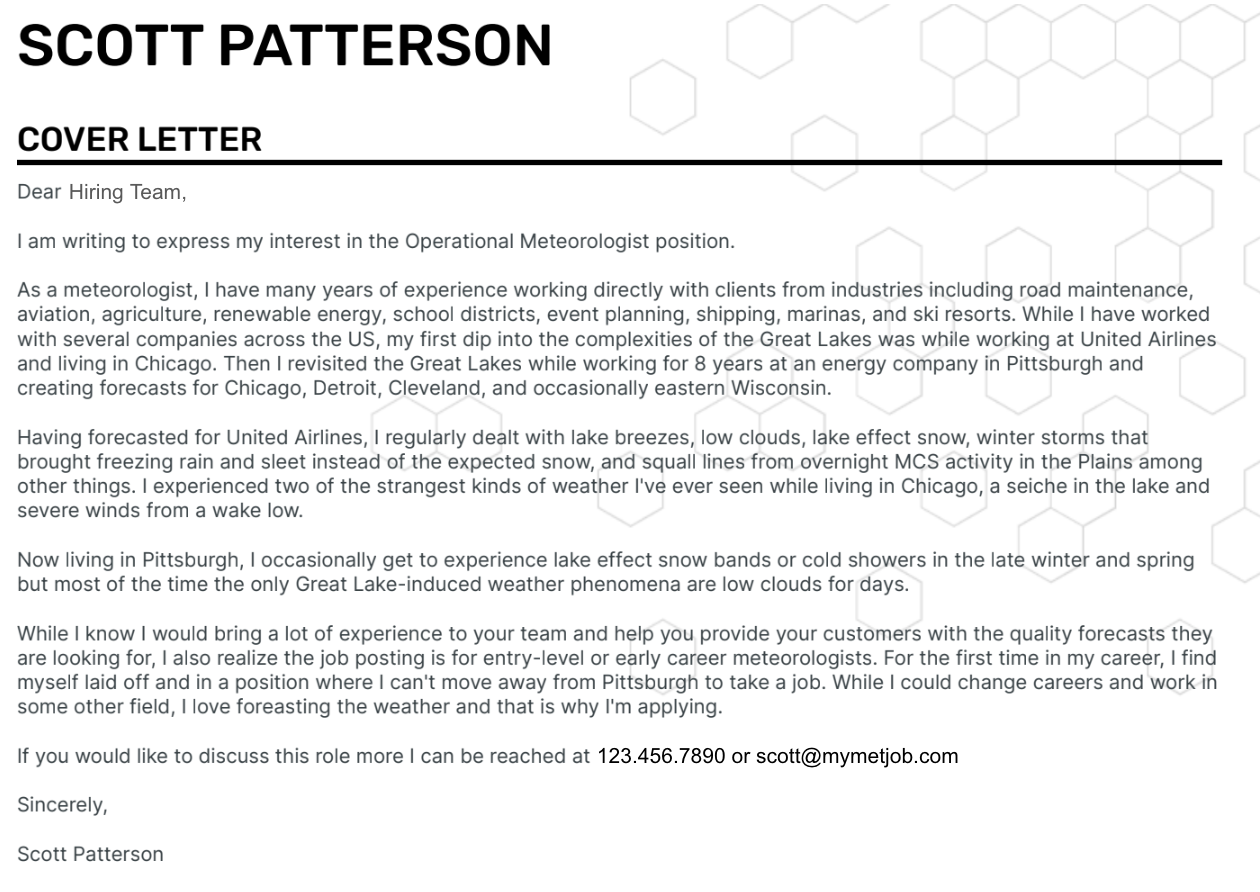
Issued on the 1st of May 2026 Below is a cover letter for a role in which I was overqualified, but it was remote, and I knew the type of company that was hiring for this role. This cover letter landed a phone interview and a forecast test.
Now, let's look closer at the cover letter. This company uses a specific business model that many small private meteorology companies use. They are a B2B company, working with other businesses that have multiple forecast sites or a need for constant monitoring, such as snow plowing or a school district. This requires a large meteorology team, which distributes income across more people and lowers annual salaries. While they may provide forecasts worldwide, their primary customer is based around the Great Lakes. They may also work with pleasure boating on the lakes and marine shipping. First-line: This is why you are sending the company a letter. The first paragraph lists all the ways I have worked with clients around the Great Lakes, and then directly ties one of my past experiences to learning how to forecast in this region. If you don't have experience, maybe you have lived near the company or near a location with similar weather, or maybe in college you studied this region. Somehow, you need to connect why you are a worthy candidate. The second paragraph continues with my best connection to the region, and because I know a lot of the people at this company are based in Chicago, where United Airlines is located. I think this builds an emotional connection between the reader and what I'm discussing. In this paragraph, I show my knowledge by listing the types of events that may occur across the Great Lakes. The third paragraph is not needed and probably just rambling at this point. The fourth paragraph is where I realize there is a gap in the job requirements and what I offer. In this case, I am way more experienced than the job posting. I know, however, unfortunately for all of you entry-level meteorologists, that a company will take experience if they can get it and keep it. This is where I acknowledge my experience level vs. the job, but then suggest why I would still be the best candidate. Now you may be wondering how the interview went. Badly. The job was entry-level, and the interview was definitely for entry-level. The forecast test was geared toward questions you might see on a test in college. I really don't use textbook definitions from college in my job, and so I'm pretty sure I came off as not very smart. In fact, I actively promote not using jargon as a meteorologist, as most clients do not understand weather terminology. This was not a fit. Now that is one type of cover letter or one type of company. Next week, I will show you another cover letter that successfully landed an interview and one where I received a job offer. The JobsUSA JobsIndustry: Media Title: Digital Meteorologist Company: CNN Work Location: Chicago, Illinois Pay: $64,190 to $119,210 per year Benefits: See Job Listing Degree:
Years of Experience:
Key Skills or Knowledge: (most important to the company)
Additional Skills:
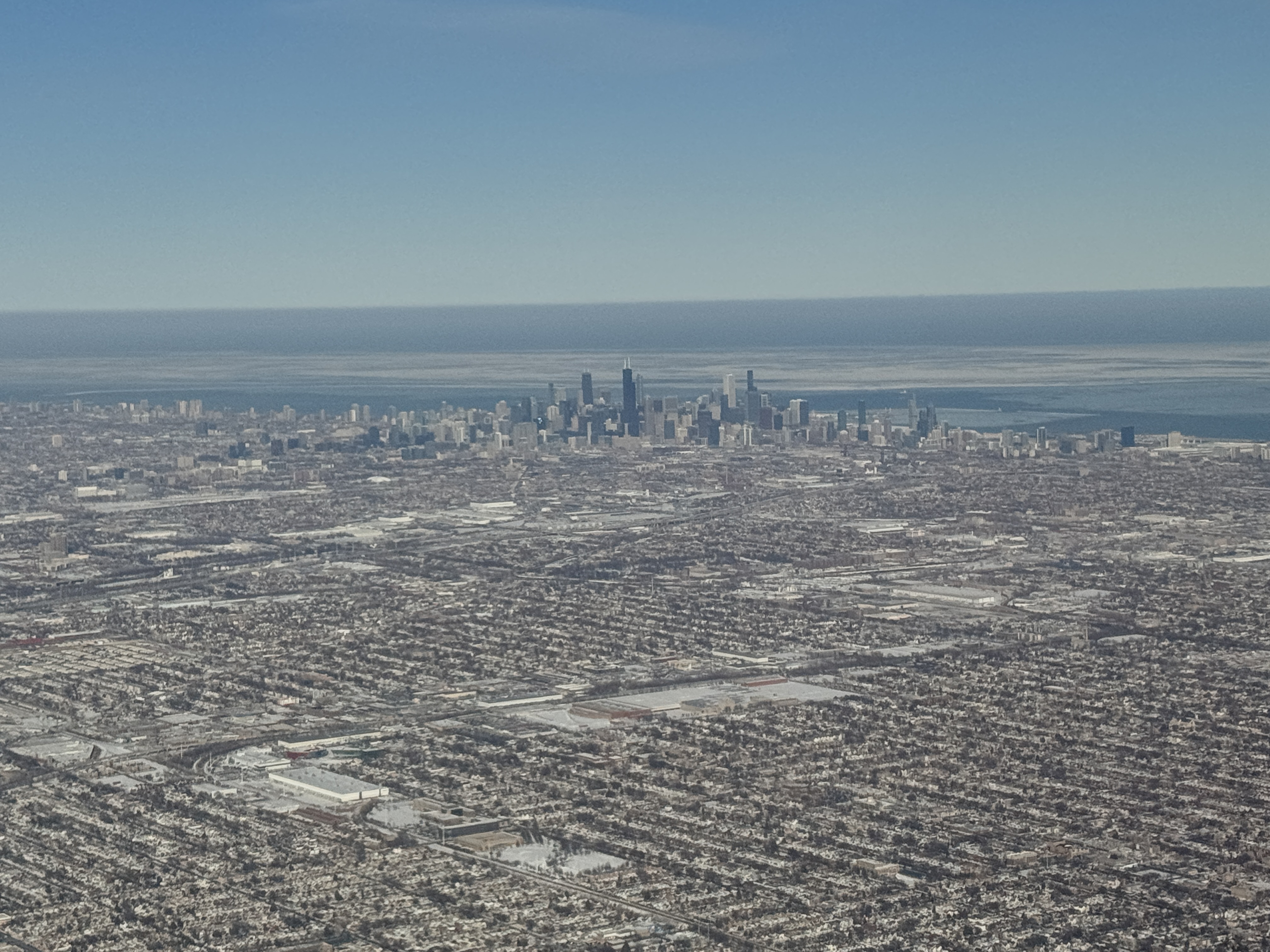
Who Should Apply? This is a great job for anyone looking to get into broadcast but not quite there. You get to work for a major media company, writing stories about the weather without being on-air. I would say that one of the things that will weed out people from applying is the 5 years in digital editorial. However, if you can write forecasts for clients and you can do it fast, on the fly, one draft, and make it compelling, then you should apply. As someone who does this daily, I find this type of job fascinating. About the Location I travel to Chicago 1 to 2 times per month to work in person with my colleagues. When I travel there, I work downtown, which is way different from working in the suburbs. Since this is CNN, they are likely based downtown. The North Side of downtown is ideal and safe. I ride on the trains all the time to get around, between the two airports, and frequently walk along the lake for exercise.
I have also lived in the suburbs of Chicago when I worked at United Airlines, and commuting sucks. The traffic in Chicago is not awesome, especially when it snows. There are some trains, the Metra, but I find it takes forever, and you might as well try to live closer in, and then you can ride one of the L trains or the red line subway. Chicago can be pretty cool with a lot of entertainment options. Winter is terrible. One time, it was so cold that the door handle on my car snapped off on the way to work. The reason this happens is that many times in the Winter, strong cold fronts bring rain and then rapidly falling temperatures that then freeze the water in the door frame and essentially freeze your doors shut. On the morning this happened, the wind chill temperature was -45 F / -43 C, so I was in a hurry to get into the car. The summers were pretty nice, though. Industry: Electric Utility Title: Meteorologist Company: Arizona Public Service Work Location: Phoenix, AZ Pay: None Given Benefits: See Job Listing Degree:
Years of Experience:
Key Skills or Knowledge: (most important to the company)
Additional Skills:
Who Should Apply? This job opening has been posted many times, but the date on their website is from the 25th of April, so I assume they are still filling the spot. This is more than just a wildfire meteorologist position, as you also focus on the monsoon and snowfall. You may just think of Arizona as a hot desert, but it's very unique in how the land rises to the North into mountains and then a plateau. On top of the plateau, near Flagstaff, sit the San Francisco Peaks, which top out at 12,637 feet (3,852 meters). The Grand Canyon is then northwest of these mountains, and snow is normal in the Winter for the South and North rims. Monsoon rains can create raging flash floods that fill normal dry creeks into wide rivers. However, they can also stir up dirt and sand and create a haboob that is driven by cold, dense outflows compared to extreme heat towards Phoenix. This is a job for someone who knows mountain meteorology, especially dry mountains, or wants to learn more about this specialized skillset.
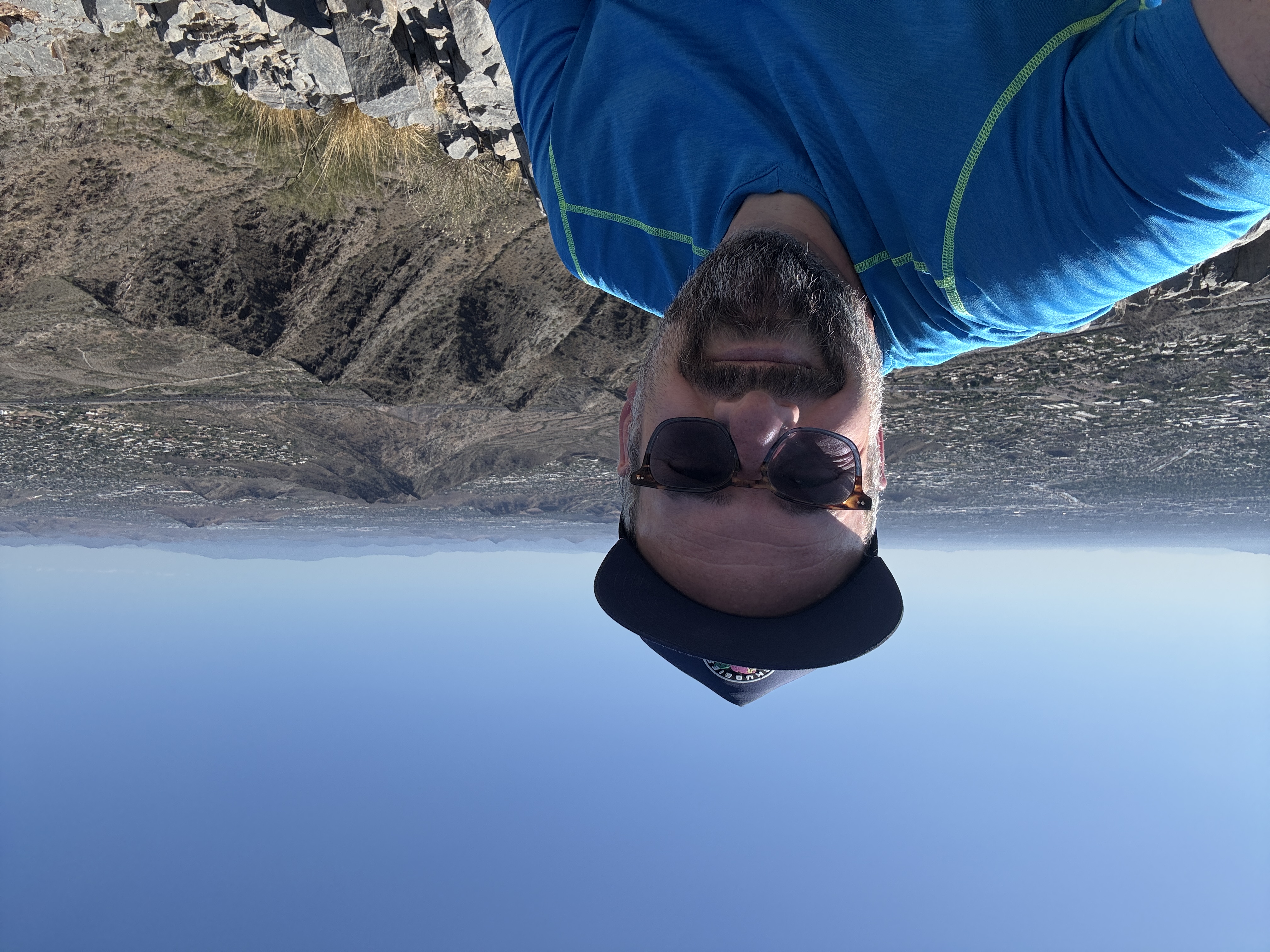
About the Location In the image above, yours truly has just hiked to the top of Piestewa Peak, which is right in the middle of Phoenix. A super popular hike, I did it in mid-April of this year, right in the middle of the afternoon, so there wouldn't be any rattlesnakes and fewer people. Even at 80 degrees F / 27 C, the sun was very intense. I had the summit to myself for a while. The hike to the top is 1,208 feet / 368 meters in 1.2 miles / 1.9 km, making it very steep. I've hiked to this peak close to 10 times in my life, so it wasn't new. The mountains you see in the distance are the start of the rising terrain heading northward towards Flagstaff.
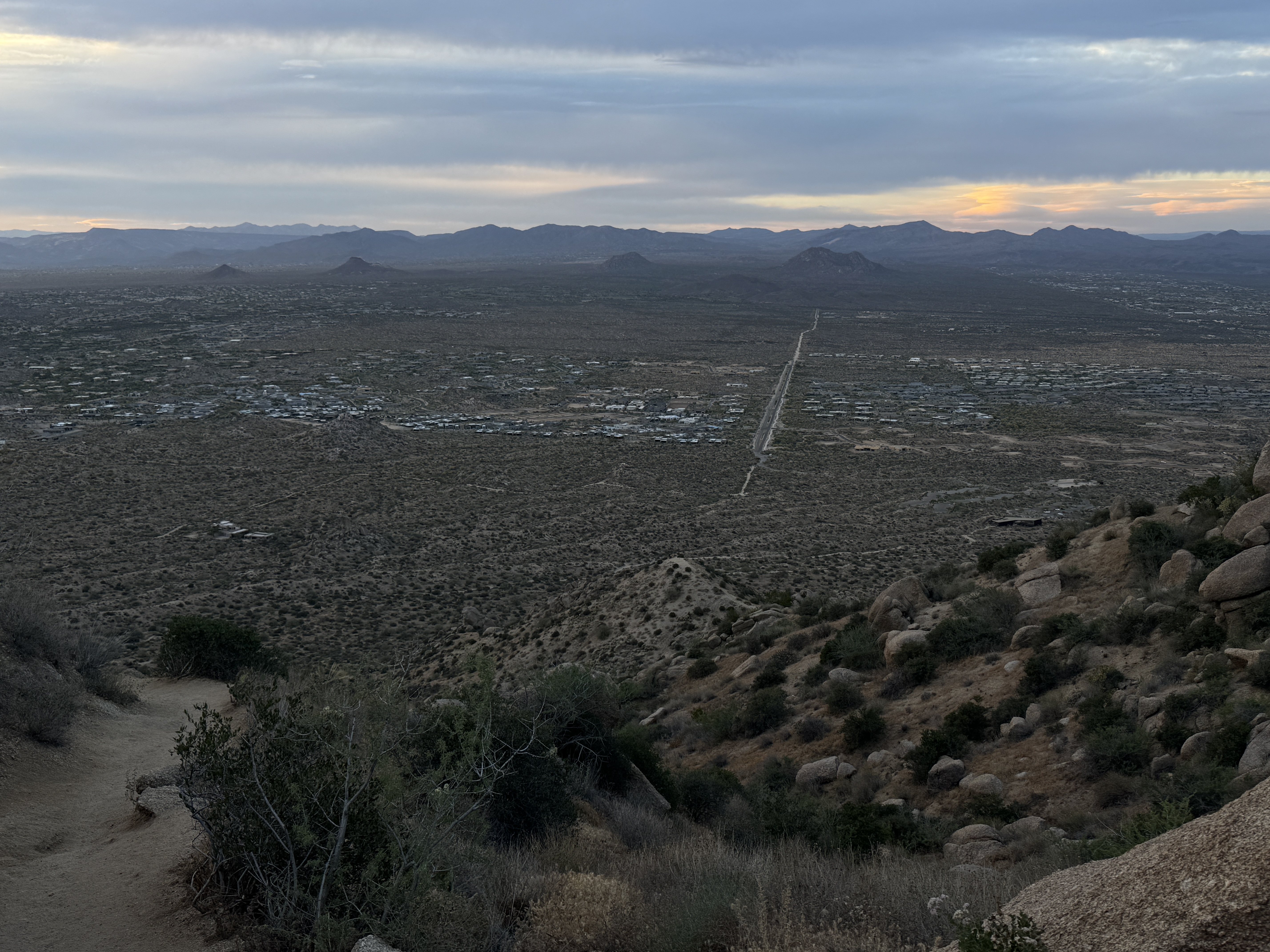
Here is a better view of the rising elevation as you head northward out of Phoenix. This is a trail called Tom's Thumb in the Northeast Phoenix metro area, and this is about midway up, looking North. So this is what Phoenix looks like. A lot of small scrub brush, and then Saguaro Cacti all over the place instead of trees. I once had a needle go into my leg while brushing by a cactus. It hurts a lot. And a lot of rattlesnakes, lizards, and on Piestewa Peak, large, too-friendly squirrels, of which I had already seen one of each by this point. While it is dry most of the time, imagine what happens when you take tropical-like rain and add it to hard, desert dirt. It runs off immediately, creating flooding. International Jobs (Outside the US)Industry: Energy Title: Senior Meteorologist Company: CGS (actual company unknown) Work Location: Rotterdam, Netherlands Pay: €4,950 - €7,700 gross per month Benefits: See Job Listing Degree:
Years of Experience:
Key Skills or Knowledge: (most important to the company)
Additional Skills
Who Should Apply? I'm not sure if this job is still available, as it has been on the CGS website for months. However, because I've had a senior meteorologist job offer in the Netherlands before, I know this is a good, decent offer package. If you are in the Netherlands or can get yourself there on your own with a work visa, then you should apply. You should love the rain.
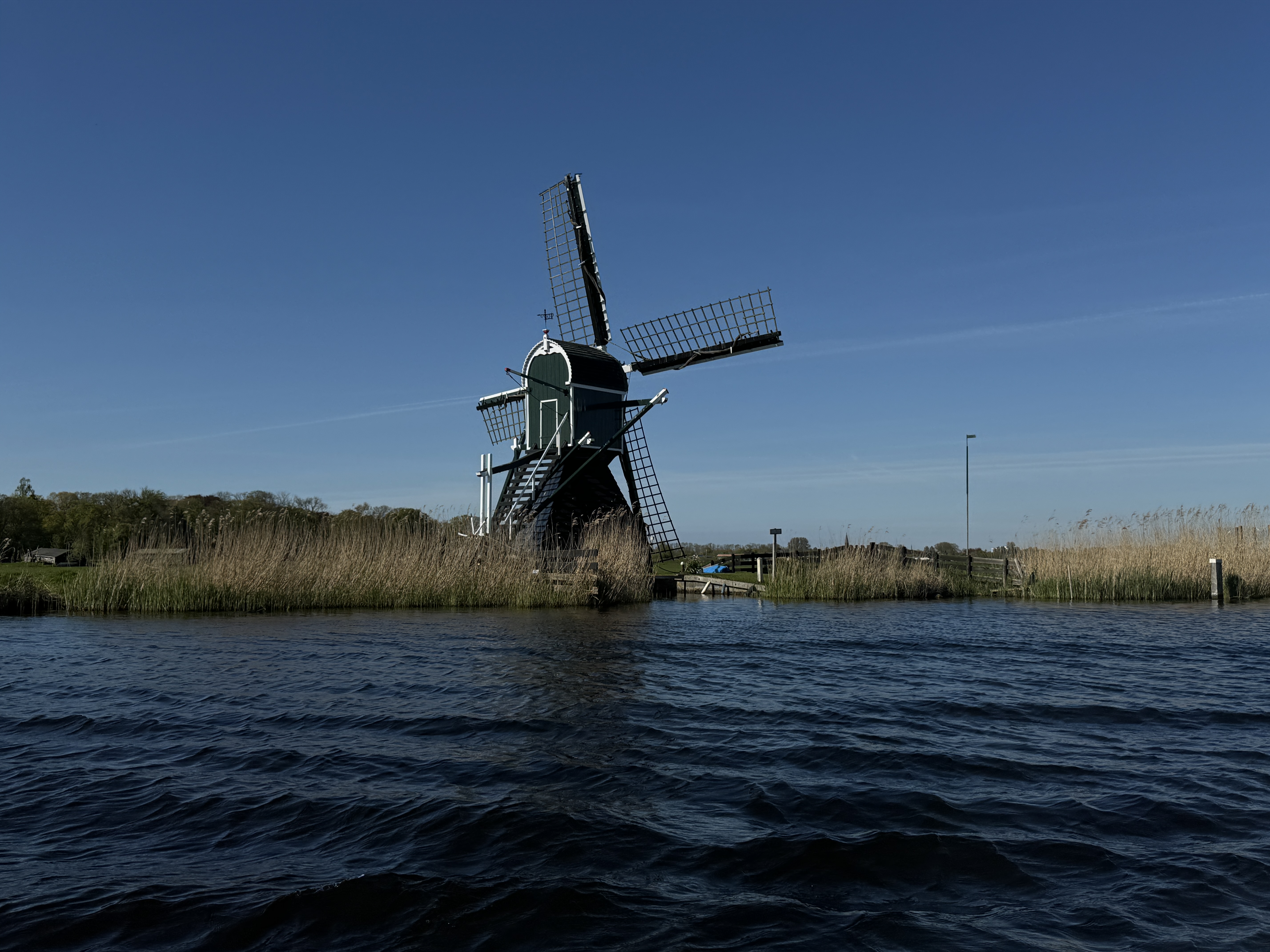
About the Location While I have not been to Rotterdam, I was recently in Amsterdam and other parts of the Netherlands, and I can tell you it is extremely flat. While I was there, it was beautiful weather, with sunny skies and temperatures around 15C / 59F. Most of the time, there are clouds and at least some rain, with dark and windy weather for long stretches in the Winter. Their bicycle game is real. There are so many people on bicycles that, as a person walking, you have to really pay attention. There is some nature, but most of the land is agriculture or grasslands. They have these strange, but tasty snacks called bitterballen and consume many, many French fries. Industry: Hydro Title: Meteorologist Company: Panama Canal Authority Work Location: Panama Canal, Panama Pay: None Given Benefits: See Job Listing Note: You must be Panamanian Degree:
Years of Experience:
Key Skills or Knowledge: (most important to the company)
Additional Skills:
Who Should Apply? While I realize few people will be qualified for this role based on the Panamanian citizenship requirement, I decided to list it due to the uniqueness and importance of this role. In 2023, the Panama Canal suffered through a significant drought, which limited the number of ships that could traverse the canal. Now, if you always assumed this canal just joined the Pacific and Atlantic Oceans via the Caribbean Sea, and why does drought matter, then you should know that the canal was built with locks and elevation gain/loss across the country, with a central lake in the center. In drought years, the lake levels drop, and the water available to fill the locks and keep the water in the locks high enough is too low, and the number of ships passing through daily needs to be reduced. Industry: Energy Trading Title: Energy Meteorologist Company: EDF Trading Work Location: London, England Pay: None Given Benefits: See Job Listing Note: Pangea and Marlin Selection Recruitment are both potentially listing the same energy trading job, as they were posted with the EDF posting on the same day. Degree:
Years of Experience:
Key Skills or Knowledge: (most important to the company)
Who Should Apply? First off, the UK is strict on giving out work visas, so even though you are very qualified, this company may go with a UK citizen first, even though EDF is a global operation. EDF is a global operation, meaning in addition to London, they also have trading desks in the US (Houston) and Asia (Singapore). When I say trading desks, that is basically a trading business operation. Each operation will be trading intra-day, next-day, weekly, monthly, and longer seasonal to annual. In addition to power markets, which include renewables, they are also involved in LNG, oil, and other commodity markets. Each type of trading desk may be separate from the others in its own room. You would be working with trades involving the UK, but also Europe. Europe operates much differently than the US, with a renewables-first approach, where the US is everything else, and then renewables. For this reason, knowing wind, solar, and hydro power can be useful. Natural gas also plays a big role in Europe based on how renewables are performing. You should apply if you are interested in working in energy, have 3+ years of experience, have actually used Python and can use it again, and have no problem sharing weather forecasts with traders, who can be quite demanding and have unique personalities. You should have a little bit thicker skin than a normal meteorologist to work on a busy trading floor. There is a video online about the EDF trading floor that is worth a quick watch.
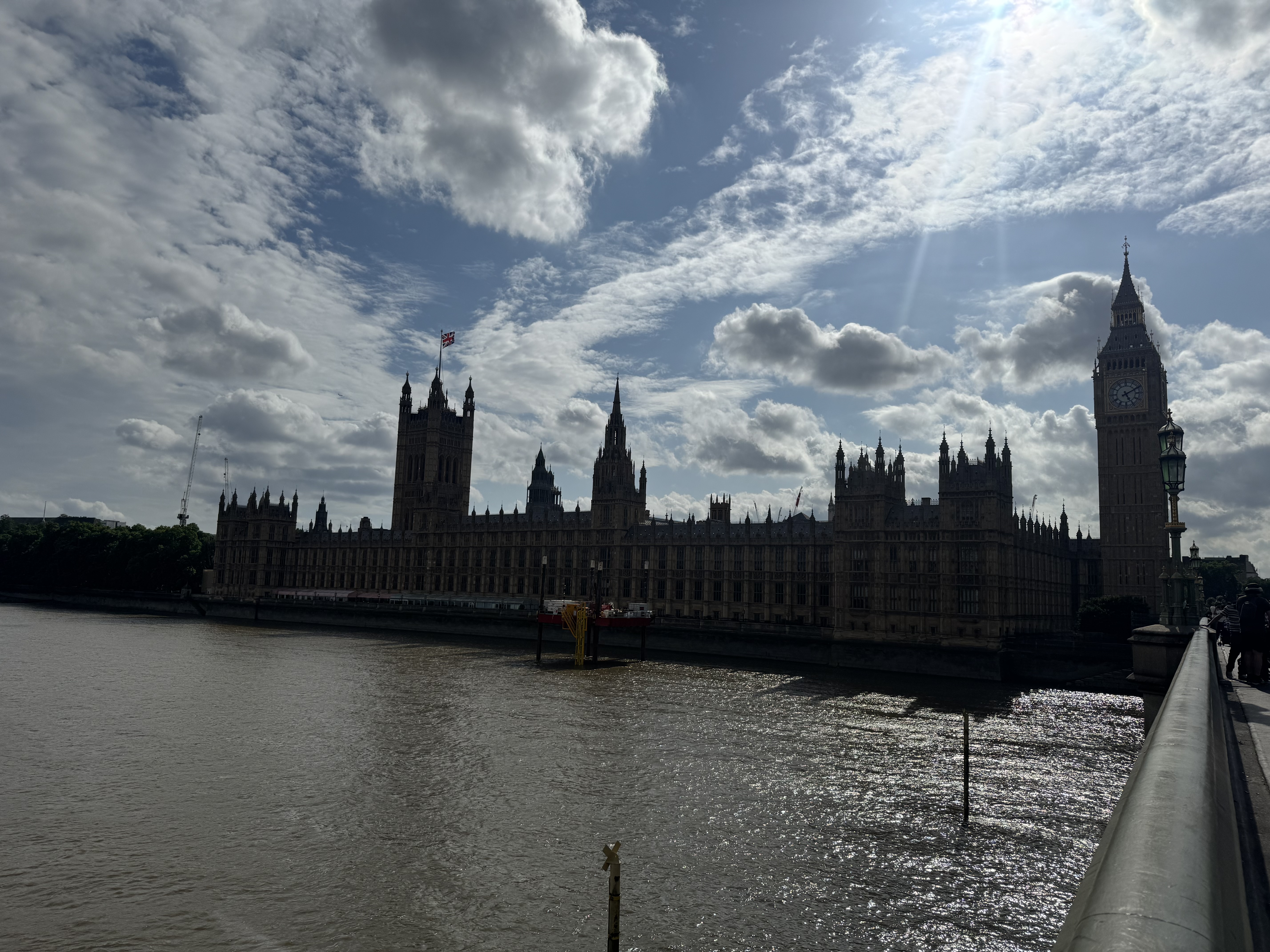
About the Location This role is more than likely based somewhere in the city, in the thick of things. If you have never been to London, it's all about the trains and them being on time. From my experience, in the morning, you may have to wait for 3 to 5 trains before you can even find a spot to cram yourself into. It is expensive to live there, and so while you can walk pretty easily around the city, you may not be able to afford to live right downtown, and that's where the trains come into play. The weather can be terrible for long stretches when the winds are off the Atlantic. Winter can see snow or just cold rain and graupel. Industry: Energy Trading Title: Energy Meteorologist Company: SSE plc Work Location: Reading, England Pay: £60,000 - £87,100 annual + bonus Benefits: See Job Listing Note: 50% of your week will be in the office. So Hybrid. Closing Date: 3rd of May, 2026 Degree:
Years of Experience:
Key Skills or Knowledge: (most important to the company)
Who Should Apply? SSE is a smaller version of EDF. They operate across six business units, with one of these developing and operating wind and solar farms, hydropower, and battery storage. Another unit is the market trading. These types of companies, in theory, have more knowledge about the market because they are building the wind farms and improving transmission. This means, especially for wind power, they understand the nuance of wind power and how subtle changes in the near-surface boundary layer can change the wind generation. As someone who has worked in energy trading more than any other industry, I've always wanted to work for one of these types of businesses because they likely have the answers to questions I had about wind and solar power efficiency, they understand hydro power more thoroughly, and it's kind of the next level to working just at a power marketer, as I did. This is a leadership position, and that is something you should want to do. Management can be a lot more work than just a normal-level meteorologist. In addition to making forecasts, designing and implementing new processes or products, you are also tasked with taking the lead on pretty much everything your team may encounter. When things don't go as planned, you take the heat. You also coach, mentor, and help your team grow in their careers. Honorable Mentions Worth Looking at for Some People Yle - On-air Meteorologist in Helsinki, Finland RTL Hrvatska - On-air Meteorologist in Zagreb, Croatia DMI - Military contractor for Denmark, with some work in Greenland - 1st of September deadline. BP Meteorologist in Singapore - One big update: they changed the posting to say they are paying for relocation. This was a big gap in the initial job announcement, as moving to Singapore is not cheap. Verisk - ML Scientist (Atmospheric Science) - Boston, MA, USA WeatherCast Solutions - Weather or Data Analyst - Mumbai, India Final Thoughts I've noticed through the job postings I see and the people I speak with that there are a significant number of jobs focused on energy, utilities, wildfire risks, and occasionally aviation or marine. I know from experience that it can be very difficult to gain the skill sets you need to get into these roles. Most US-based companies will not provide any sort of training and just throw you into the deep end and expect you not to sink. European-based companies, on the other hand, provide extensive training. This means you need to learn on your own or work with someone to learn these skills. That someone can be me, and the My Met Job platform. Everyone is busy with work, looking for work, and life, and this includes me. However, in the nooks and crannies or the small downtime I have, I am developing asynchronous courses to teach you exactly what you need to know to apply for any job you want. You may say, "But Scott, companies want experience". I have a solution for the experience gap, which I will introduce with the courses. I hope to have the first short course on energy trading ready by the end of May. I was and may still do an instructor-led course, but for now, it will be something you can do on your own schedule. In the meantime, you can always take a COMET module or visit Haby Hints, a great free resource for understanding the atmosphere. Good luck on the job search! |
Scott Patterson
Every Friday, I break down real meteorology job postings and cover what the role actually involves, what employers are really looking for, and how to position yourself to get hired. Experience in energy, aviation, agricultural commodities, transportation, outdoor recreation, and event forecasting. Free, every Friday