Every Friday, I break down real meteorology job postings and cover what the role actually involves, what employers are really looking for, and how to position yourself to get hired. Experience in energy, aviation, agricultural commodities, transportation, outdoor recreation, and event forecasting. Free, every Friday
The Friday Job Report - Week 15
|
Issued 10th of April 2026 Continuing with the discussion from last week about resumes, here are some tips about modular resume design. HeaderThis should clearly state your name in the largest font you use on the resume, at least twice as large as any other section titles. This is the top of my resume. I use sans-serif font. Then, contact information below. You don't have to link to your LinkedIn; you could use your own website or anything else that would cast you in a good light.
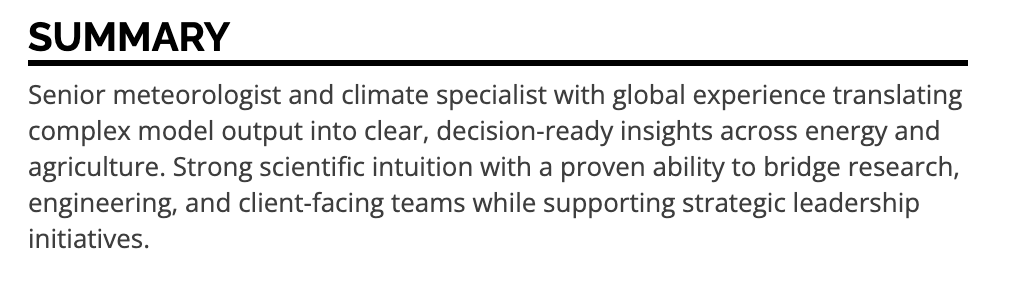
There are variations on everything, and this is just the format I use. While you can design your resume however you want, the one thing to stay away from is getting fancy with the font style or color. Your resume is not about showing your flair. That is what LinkedIn, a website, or some other social media site should be used for. SummaryI like to add a summary at the top that wraps up my experience into a short paragraph. I don't use the same summary for every job; instead, I change it up depending on the type of job. Whatever job opening I used this resume for, it was likely something very specific, as the content of the summary is climate and engineering-focused. This was probably a stretch job where I wasn't completely qualified, so I used big words to make it sound like maybe I knew more than I do.
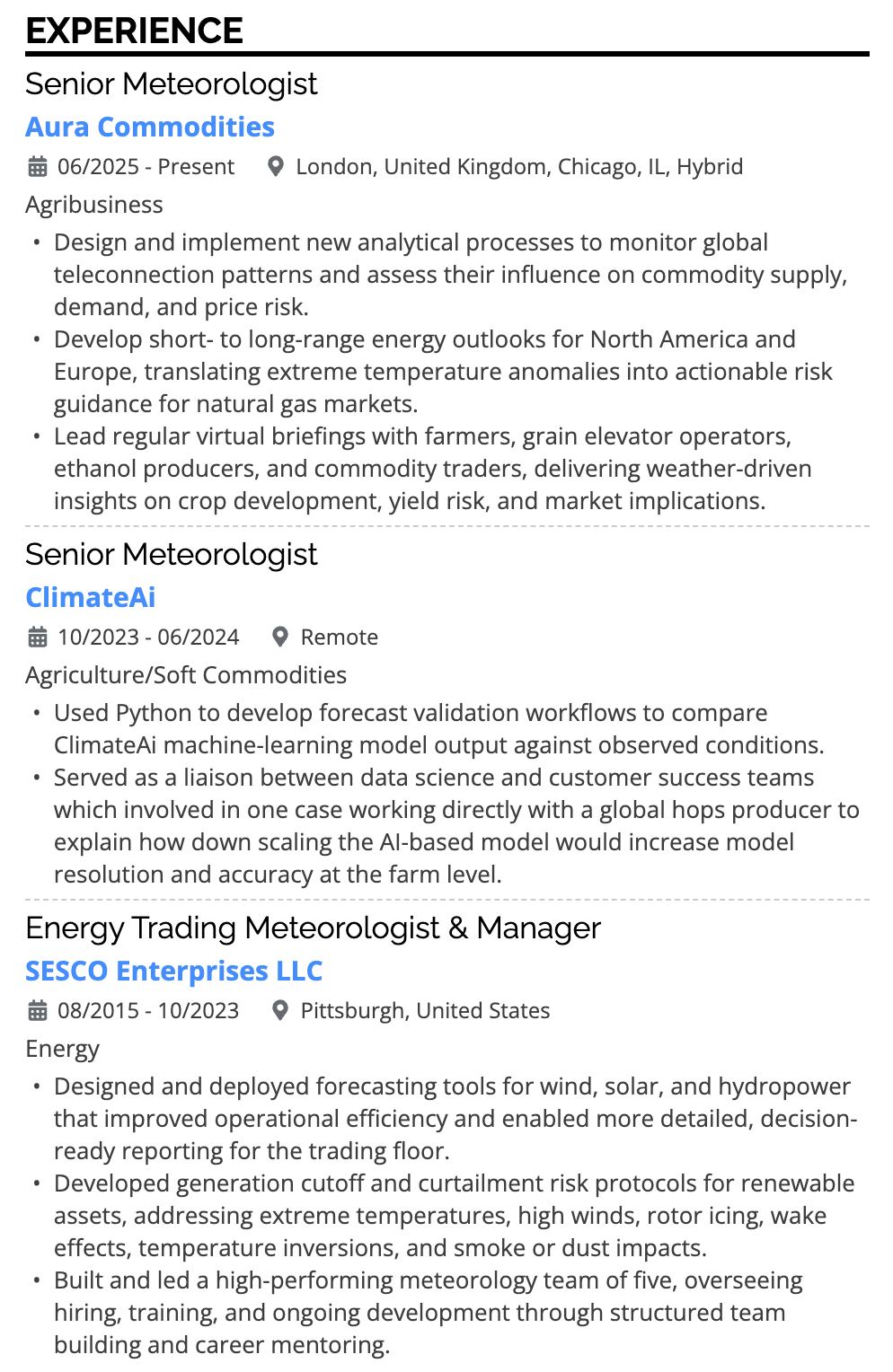
Often, I write a paragraph on my own and edit it until it reads just like I want, then I run it through AI and ask for a compressed 2-line example. I don't necessarily use this; I just want to compare what I said to what the AI thinks. ExperienceLook at my LinkedIn and compare it to my resume. My resume is very concise, compressed down to a few bullets per job experience. While my LinkedIn is a mess, with too much information. (I've kept my LinkedIn like this on purpose for you, the reader, to see what really goes on at different types of jobs.) First job. Make sure that if you are still working there, you are using the present tense. I used 3 bullet points for this resume. Sometimes, if the lines are shorter, I will use up to 5.
The most important detail about each job is what your title was, so put it first above the company. Hiring managers don't usually care where you worked. Then I put the company name and make it stand out using a blue color. The only color other than gray or black on the resume. I would pick 1 to 3 colors and stick with that. Don't go full rainbow. You can do that somewhere else online. Now I could flip the color highlighting effect to my work title. Either would work. I don't think there are any spelling issues, and you want to edit this over and over to make sure the spelling is good and the grammar is correct. I'm terrible at grammar, so I use Grammarly (free version) to check issues. It's not perfect, but it helps. On purpose, I have made this a 1-page resume. For me, this is because in these 3 jobs I have 10-years of experience, and the experience in each job is what I'm connecting to the opening. These are just some ideas to consider when you are designing your resume. The JobsUSA JobsIndustry: Television Media Title: Meteorologist Company: Synergis Work Location: Atlanta, GA Pay: $25 - $45/hour W2 contract Benefits: See Post Degree:
Years of Experience:
Key Skills or Knowledge: (most important to the company)
Additional Skills:
Who Should Apply? Normally, I would not list a TV job, but this one is not really an on-air role, although it could expand in that direction. If you are not sure about on-air or where you want your career to go, this could be a good opportunity. You should have experience in creating copy for this type of work, so you understand the type of information that is for television media. Sounds like an interesting gig for the right person. Industry: Climate Resiliency Title: Environmental Project Coordinator Company: Broward County, Florida (near Miami) Work Location: Ft Lauderdale, Florida Pay: $70,300 - $112,200 Benefits: See Job Posting Degree:
Years of Experience:
Key Skills or Knowledge: (most important to the company)
Who Should Apply? If you are a little more interested in climate, especially climate resiliency, or you can't find any jobs, then I would consider going this route. The job description is pretty much written where you could answer every requirement with something you do as a meteorologist. About the Location It doesn't snow. Fort Lauderdale. The Beach. Nothing else to say. International Jobs (Outside the US)Industry: Hydrology Title: Chief Specialist Company: Institute of Meteorology and Water Management Work Location: Warsaw, Krakow, Wrocław, Poznań, Gdynia all in Poland Pay: None Given Benefits: See Posting Degree:
Years of Experience:
Key Skills or Knowledge: (most important to the company)
Additional Skills:
Who Should Apply? You should speak and read Polish or plan to learn it, even though the job specifically states English; it may be beneficial if you can speak to your colleagues. The job reads more like it is a climate research sort of role, but the listing does mention long-range forecasting. Closing Date: 13th of April 2026, so this Monday. Industry: Marine and Road Weather, and some Energy Title: Operational Meteorologist Company: WSP Work Location: Ottawa, ON, Montreal, QC, St. John's, NL, all in Canada Pay: $54,200 - $75,600 CAD per year Benefits: See Listing Degree:
Years of Experience:
Key Skills or Knowledge: (most important to the company)
Additional Skills:
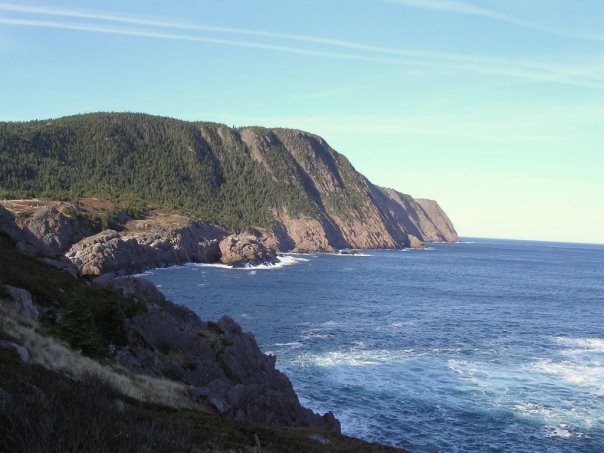
Who Should Apply? Please note that basic French is required, as the job contract I had when I lived in St. John's, Newfoundland, requires speaking with clients in Quebec and New Brunswick (both bilingual provinces). I didn't speak any French, but we had a cheat sheet. If you are looking to get into meteorology, even if you don't speak French, apply and see where it goes. If they have already posted this once, then they may be willing to forget you don't know French. This could be your first job as a meteorologist. About the Location St. John's, Newfoundland You should like cold weather. St. John's, Newfoundland. It feels like it is sunny for 1 month of the year and cloudy and wet the other 11 months. It is super windy, occasionally gets hit by a hurricane, has heavy ice storms, heavy snow, very dense fog, and little to no thunder or lightning. There are more moose than people, and they have a daily moose report on the radio because hitting a moose with your car is like running into a brick wall, so I've heard.
Montreal and Ottawa I've never actually been to either, but I do know they are both extremely cold in the winter and that Montreal is supposed to be a lot of fun even with the cold. Both are pretty close to the US, and you could easily just drive across the border. Final ThoughtsWriting a resume is not easy, but it doesn't have to be the make-or-break between you getting a job or not. If you struggle with resume writing or are not having any success getting through, I would suggest you work with someone, anyone. All you need is a template and a starting point that you can replicate with your own experience. Once you find something that works, you can mostly repeat it. If you find yourself in this spot, where you can't seem to get any traction, I've written dozens of resumes for myself, many variations that have landed interviews, and others that have not. I have even re-written resumes for other meteorologists. Reach out if you want some help or need some direction, scott@mymetjob.com |

Scott Patterson
Every Friday, I break down real meteorology job postings and cover what the role actually involves, what employers are really looking for, and how to position yourself to get hired. Experience in energy, aviation, agricultural commodities, transportation, outdoor recreation, and event forecasting. Free, every Friday